

[ad_1]
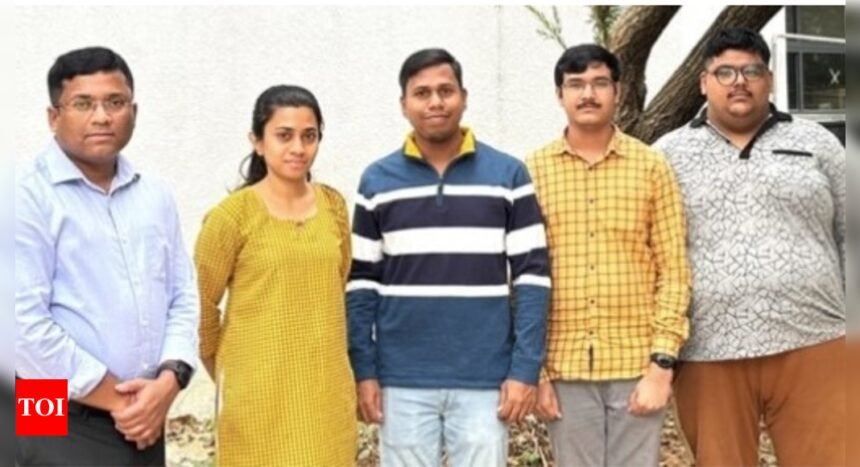
BENGALURU: Indian scientists have discovered a new phenomenon in nanoscience that could change how we develop electronic devices, sensors, and catalysts. The research, led by Prof Bivas Saha from the Jawaharlal Nehru Centre for Advanced Scientific Research (JNCASR), Bengaluru, reveals how electrons behave differently when confined in metals at the nanoscale.
The study, published in Science Advances, demonstrates for the first time how this confinement disrupts the normal plasmonic properties of metals — a finding that challenges traditional understanding of metal behavior at the molecular level. The work was conducted in collaboration with scientists from Purdue University and North Carolina State University in the USA, and the University of Sydney.
“Our findings highlight the transformative role of quantum confinement in redefining material properties. This is not just about understanding plasmonic breakdown—it’s about pushing the limits of how we can harness nanoscale phenomena for technological innovation,” explains Saha.
The research team used advanced techniques including electron energy loss spectroscopy and quantum mechanical calculations to observe and predict electron behaviour with unprecedented accuracy.
Lead author Prasanna Das describes the discovery as “a landmark achievement in materials science and nanotechnology.” The implications are far-reaching, promising advancements in optoelectronic materials, high-precision sensors, and more efficient nano-catalysts.
The team also argued that the breakthrough could position India at the forefront of nanoscience research, where classical and quantum physics intersect. The Department of Science and Technology (DST)-supported study marks a step forward in understanding how materials behave at the smallest scales, potentially leading to more efficient and powerful electronic devices in the future.
“The research opens new possibilities for developing advanced technologies across multiple industries, from electronics and photonics to energy conversion systems, reinforcing India’s growing capabilities in cutting-edge scientific research,” DST said.
[ad_2]
Source link