
[ad_1]
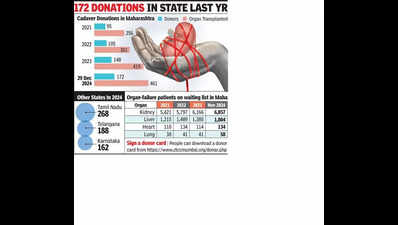
Mumbai: The number of deceased organ donations in Maharashtra increased in 2024, with 172 families donating their brain-dead relatives’ organs to help 461 patients with organ failure get a fresh lease of life. While 60 of the donors were from Mumbai, 70 were from Pune, and the rest from Nagpur (39) and Chhatrapati Sambhajinagar (3), according to state health officials.
In comparison to 2023, when 148 donations were made, the state registered a 16% increase. Compared to the Covid-hit 2021, when only 95 deceased or cadaver donations took place, 2024 registered an 80% rise. The growth is visible across the country, with authorities stating that the country will once again cross the 1,000-mark like last year. Dr Surendra Mathur of Zonal Transplant Coordination Centre (ZTCC), which coordinates the sharing of organs between various hospitals in Mumbai, said that the biggest change this year was the fact that more states, especially in the north, began cadaver donation programmes. “In 2024, donations increased in Delhi, Punjab, Rajasthan, and Orissa. This is a healthy trend in the country. While we are far from realising our entire potential, it’s a good start,” said Dr Mathur.
It is estimated that thousands of people are detected with organ failure every year, but less than 5% get access to transplantation. While live donation from a relative is a possibility for many, some may not have the option due to different blood groups within families or due to chronic diseases among potential family donors. Hence, a cadaver donation programme in which organs are retrieved from brain-dead donors is important.
In Maharashtra, 1,437 patients benefitted from 520 organ donors between 2021 and 2024. According to data available from the state authorities, 8,893 patients have registered for organ donation and are still on the waiting list. While 6,857 patients are waiting for a kidney, another 1,804 are waiting for a liver.
“The growing number of donations in the last few years is good, but we now need to sustain this and grow further. This is where policy decisions are needed at the central level, and states have to implement them,” said Dr Mathur, who believes it’s time to appoint an independent authority in the state to oversee the cadaver donation programme.
[ad_2]
Source link